Difference between revisions of "Rainwater harvesting: Sizing and modeling"
Jump to navigation
Jump to search
Jenny Hill (talk | contribs) |
Jenny Hill (talk | contribs) |
||
| Line 1: | Line 1: | ||
| − | |||
| − | |||
<h4>Rapid</h4> | <h4>Rapid</h4> | ||
Cistern size can be estimated by multiplying the depth | Cistern size can be estimated by multiplying the depth | ||
| + | |||
| + | <gallery mode="packed" widths=300px heights=300px> | ||
| + | Cistern Size.png| Schematic diagram of the inputs and outputs to a rainwater harvesting cistern | ||
| + | </gallery> | ||
===Interactive Sizing Tool=== | ===Interactive Sizing Tool=== | ||
Revision as of 09:28, 5 June 2017
Rapid
Cistern size can be estimated by multiplying the depth
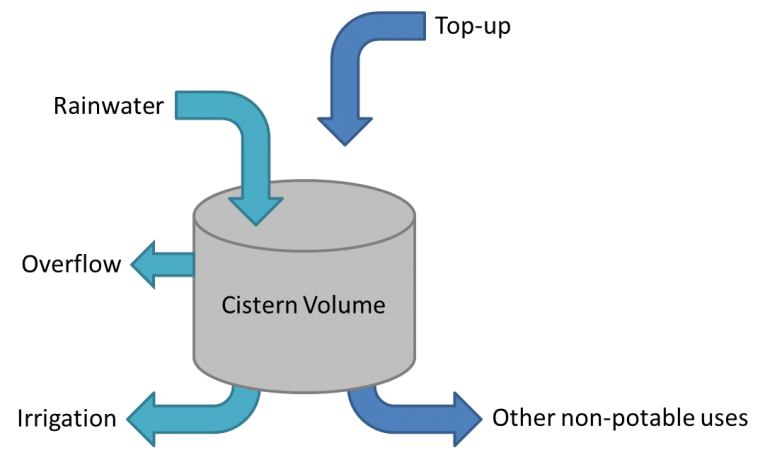
Schematic diagram of the inputs and outputs to a rainwater harvesting cistern

Interactive Sizing Tool[edit]
The Sustainable Technologies Evaluation Program have produced a rainwater harvesting design and costing tool specific to Ontario. The tool is in a simple to use Excel format and is free to download.
<panelInfo> RWH Sizing Tool </panelInfo>
The Treatment Train Tool[edit]
Once the size of cistern has been determined, it can easily be modelled in many open source and proprietary applications.
In addition to the cistern size, modelling requires <btnPrimary>The Treatment Train Tool</btnPrimary>